
A comedian for the company party: how to make the humour land when the whole staff is together
A company party is one of the hardest shows you can do. Not because people are grumpy, but because they're so different. Management sits at one table, the warehouse at another, and somewhere in the room sits someone who started on Monday and doesn't know a single one of the stories the rest of the company has been laughing about since last summer's party. If you're booking a comedian for your company party, that's exactly the challenge the humour has to be able to handle.
Why a company party is harder to get right than an ordinary party
At a wedding or a milestone birthday, everyone in the room has one thing in common: the guest of honour. You know the couple or the person celebrating, you share an occasion, and the mood is set long before the entertainment begins.
At a company party, the only thing everyone has in common is the workplace. The age gap can be forty years. Some have been there since the 90s, others since last Tuesday. Some are sitting with their closest colleagues, others have been placed at a table with people from a department they've never spoken to. And somewhere in the room sits the boss, which changes how loudly people dare to laugh at certain things.
That's why the comedy that works perfectly in a comedy club in Vesterbro at 10 pm doesn't automatically work at a staff event at 7 pm. The audience hasn't chosen to be there in the same way. They're there because there was a company party.
What makes the humour land with the whole staff
The most important rule I work by is that the humour has to be about things everyone in the room knows, not about individuals. What really brings a staff together is recognition. The coffee machine, the meeting culture, the email everyone got, the thing everyone grumbles about a little. When 120 people laugh at the same thing, and half of them look at each other while they do it, the atmosphere loosens up for the rest of the evening.
What can kill a company party, on the other hand, is humour at the expense of one particular employee. It might get big laughs for two seconds, but that person has to show up for work on Monday morning. That's why I never single anyone out, and I don't pull people up on stage to make fun of them. The guests I bring up or involve along the way always leave as someone the rest of the room thought was cool.
The last thing that decides whether it hits the mark is research. I always ask questions beforehand, and the ones I get the most out of are rarely about the practical details.
How well do people in the company actually know each other? Is it a place where the same people have eaten lunch together for ten years, or is half the room really meeting for the first time that evening? What kind of humour is there in the company, and what do they themselves find funny? And who exactly is coming to the event? Is it just management, or a mix from across the whole organisation?
It might sound like small things, but a good conversation before the show means I can tune in to the culture long before I'm standing in the room.
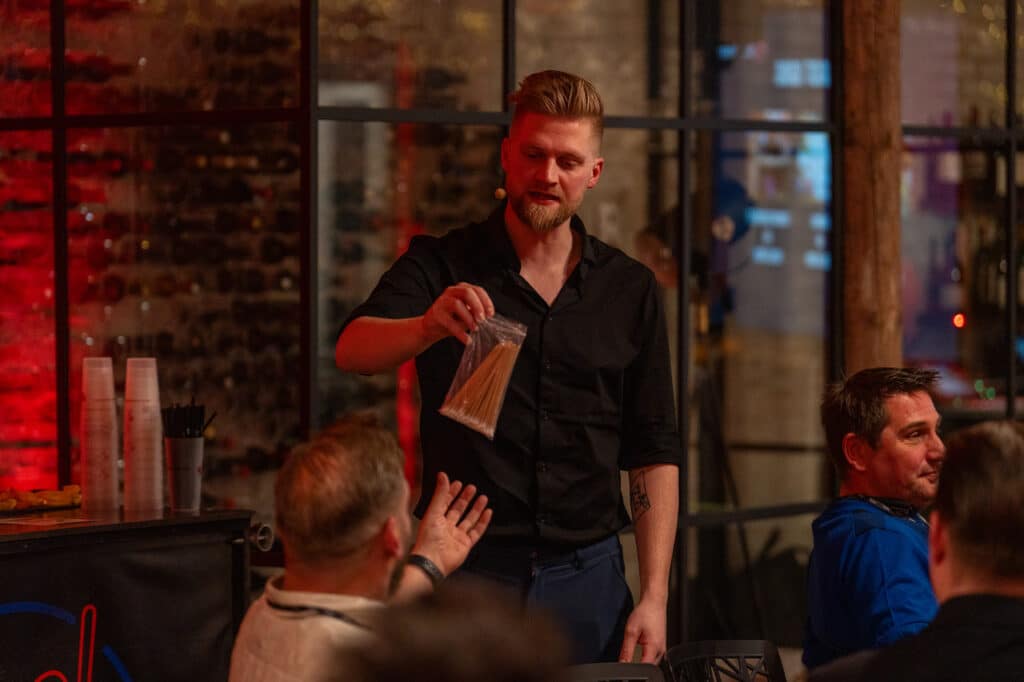
Why I bring magic into the company show
There's a very practical reason I rarely do pure stand-up at a company party, and it has nothing to do with wanting to show that I can do both.
Stand-up requires people to listen. It needs to be reasonably quiet, people need to be sitting more or less together, and they have to give the show a couple of minutes before they make up their minds. Magic only requires people to look. It works even while plates are still being cleared, and even when three tables are halfway out of their seats to get a beer. The magic buys the attention, and once it's there, the comedy can do its work.
It also means I can adjust along the way. If the room feels heavy after a big dinner, I let the magic take up more space, because it doesn't ask anything of them. If they're ready from the first second, I turn up the banter and the jokes between the tricks. I've written more about the difference between the two, and why you don't have to choose, in the post about magician or comedian.
What time of day should the act be?
I get asked that more than anything else, and the answer depends on what kind of company event it is.
At an evening party, it usually works best once people have gathered and eaten, but before the bar really takes over. That's when the energy is high and people can still focus on something together. If the act comes too late, it competes with the dance floor and with the conversations that have finally got going.
For a daytime event, a conference or a kickoff, the picture is different. Here, an act often works best as an opener that gathers everyone’s attention and sets the tone before the main programme begins, or as a closer that sends people off in a good mood. For example, I did the entertainment for Restaurant Flammen’s kickoff with 750 employees. There I went on as one of the first things after people had arrived, to kick some energy into the room and give people something to talk about over dinner.
And then there's the kind of company event where the setting is loose to begin with: the reception, the Friday bar, the long arrival before dinner. There, the timing of a show in front of all the guests can be more flexible. Something that can also make a lot of sense is for me to walk around doing close-up magic for the guests instead, a few people at a time, while they stand with a glass in hand. That's also the format that best breaks the ice between departments that otherwise don't talk to each other.
Does your company party need an act that works for everyone?
The short version is that a company audience doesn't need the funniest comedy, it needs the comedy everyone in the room is on board with. That takes knowing the setting, asking questions beforehand, and having more than one trick up your sleeve.
If you want to see what it looks like in practice, you can read more on the page about entertainment for company parties, read about how it went at Danish Chamber
of Commerce, or see what other companies have said afterwards on the reviews page.
If it's the Christmas party you need entertainment for, I've written a full guide to booking in good time. And if you already have a date in the calendar, write to me here with the date, venue and number of guests, and we'll work out what suits your party.